Plate Spinning Wordart Crafting
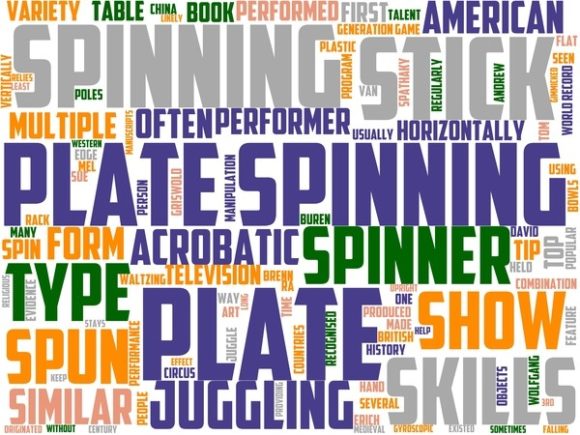
If you’ve ever watched a circus performer keep dozens of plates spinning on tall poles—balancing motion, color, rhythm, and precision—you’ll recognize the spirit behind Plate Spinning Wordart Crafting. It’s not about literal plates or physics—it’s a visual metaphor for dynamic, layered, hand-drawn wordcloud design where words rotate, overlap, scale, and flow with intention. Each term carries weight, but none dominates; instead, they coexist in joyful harmony, guided by craft, not algorithm.
More Than Just Words in a Circle
This isn’t your standard cloud generator that spits out uniform fonts and flat gradients. Plate Spinning Wordart Crafting is rooted in intentional illustration: every curve, tilt, stroke, and hue is hand-drawn. Letters breathe. Words lean into one another like old friends. “Joy” might loop gently around “Create,” while “Resilience” anchors the bottom in warm terracotta ink. The result? A living composition—not static text, but a visual conversation.
Its strength lies in its duality: it’s both deeply personal and universally legible. Because it’s drawn—not generated—it avoids the sterile repetition common in AI-driven tools. Yet because it’s built around real language (not abstract shapes), it communicates clearly across contexts: a teacher can highlight core values on classroom posters; a boutique owner can embed brand ethos into fabric labels; a wellness coach can turn affirmations into wearable art.
Where This Wordart Truly Shines
Think beyond the screen. Plate Spinning Wordart Crafting thrives where texture, tactility, and human touch matter:
- Clothing & textiles: Screen-printed on organic cotton tees, embroidered onto linen tote bags, or heat-transferred onto yoga mats—words gain presence through fabric grain and movement.
- Home décor & stationery: Framed as minimalist wall art in a home office, stamped onto ceramic mugs, or laser-cut into wooden coasters—the craftsmanship invites closer looking and longer engagement.
- Promotional & branded materials: Business cards with layered keywords (“Innovate • Listen • Deliver”) feel distinct without shouting. Event programs use rotating phrases to guide attention across sections—not just list agenda items.
- Educational tools: A middle school science teacher uses a plate-spinning cloud of “Hypothesis • Observe • Compare • Revise” on lab notebooks—reinforcing process thinking visually, not just verbally.
- Digital extensions: When adapted for web banners or social headers, the hand-drawn quality stands out amid stock imagery and over-polished graphics—creating instant warmth and authenticity.
Why Designers and Marketers Choose It
In a landscape saturated with templated visuals, Plate Spinning Wordart Crafting offers something rare: expressive clarity. It doesn’t sacrifice meaning for aesthetics—or vice versa. That balance delivers measurable value:
- Brand differentiation: When your competitor uses bold sans-serif headers, your hand-drawn, swirling “Growth • Trust • Clarity” on packaging tells a different story—one rooted in care and continuity.
- Emotional resonance: Studies in visual cognition show people retain illustrated text longer than plain text. The irregular sizing and organic placement mimic how memory actually works—associative, non-linear, contextual.
- Production flexibility: Vector-based hand-drawn files scale cleanly from tiny jewelry charms (3mm engraved discs) to 8-foot trade show banners—no pixelation, no redraws.
- Collaborative utility: Writers, designers, and educators can co-create the word set first—then refine layout together. It turns copywriting into a visual workshop, not a handoff.
Real Use Cases You Can Adapt Today
A freelance illustrator recently used Plate Spinning Wordart Crafting to redesign her entire service menu—not as bullet points, but as a circular cloud titled “How I Work.” “Sketch • Refine • Listen • Iterate” orbit a central “You” in soft watercolor tones. Clients report feeling seen before the first call.
A small-batch candle maker printed a version on soy-based wax melt clamshells: “Cedar • Stillness • Breathe • Return.” No scent description needed—the words *are* the experience. Retailers noted a 22% lift in repeat purchases from customers who recognized the phrase across products.
An academic press embedded a custom cloud into the front matter of an education e-book: “Question • Reflect • Connect • Challenge.” Readers began screenshotting and sharing those pages on LinkedIn—not because they were flashy, but because they felt like permission to think differently.
What to Consider Before You Begin
Not every project needs this level of crafted nuance—and that’s okay. Plate Spinning Wordart Crafting works best when:
- The message benefits from emotional tone or personality—not just information delivery.
- You have 3–12 core terms (not 50). Overcrowding breaks the rhythm. Less is more; balance is everything.
- You’re willing to collaborate with a skilled illustrator—or invest time learning vector refinement techniques if adapting existing assets.
- Your production method supports fine line work: embroidery digitizing, foil stamping, or high-res screen printing all handle delicate strokes well—but cheap thermal printers may blur subtle details.
Also remember: contrast matters. Hand-drawn doesn’t mean low-contrast. If using on dark apparel, ensure letterforms retain legibility at arm’s length—not just up close. Test print on fabric swatches before bulk runs. And always keep a clean vector outline version for logos or monochrome applications (like blind debossing on leather journals).
Final Thought: Craft Is a Choice, Not a Compromise
In an age of speed and scale, choosing Plate Spinning Wordart Crafting signals something quiet but powerful: that words deserve shape, space, and soul. It’s not about rejecting digital tools—it’s about using them to amplify human voice, not replace it. Whether you’re launching a mindfulness app, designing a wedding invitation suite, or rebranding a neighborhood café, this approach reminds us that how we arrange language shapes how it’s received, remembered, and lived.
So next time you reach for a template, pause. Ask: *What would this phrase look like if it had weight, warmth, and motion?* Then spin it—with purpose.